For I long to see you, that I may impart to you some spiritual gift to strengthen you -- that is, that we may be mutually encouraged by each other's faith, both yours and mine. Romans 1:11-12
I think this verse has a lot to say about discipleship. Our temptation is to think of discipleship as a one-way stream of information flowing down. The reality is that the flow-chart of discipleship looks more like a bowl of spaghetti, with arrows going all over the place between all of our relationships.
Thursday, January 7, 2010

Friday, October 30, 2009
Learning...
We had lunch today with a couple from our church. They are homeless. Later, as I walked by a convention of men in suits getting out I was feeling the need to compare myself to them. So I thought, I've sat in meetings with Michael Dell and the likes. Then I realized that what I learned from them was not nearly as valuable as what I've learned from this homeless couple.
Sunday, October 4, 2009
A Sabbath of Salvation
Works are to Salvation what the work week is to the Sabbath. I know, that sounds too much like the SAT or GRE, but….
I have wrestled often with the notion of the Sabbath and with the concept of “rest” in Scripture. Jesus says, “Come to me all who are heavy laden, and I will give you rest…” (Matt. 11:28). But what does “rest” mean? Likewise, what does “rest” on the Sabbath mean? Is it just doing nothing? Does it involve sleep? Is it something else?
I have had a couple of breakthrough thoughts on the Sabbath. The first was realizing that works of mercy are not only permissible, but commanded to be done on the Sabbath. The second involved a realization that Sundays are a time when we can (and should) turn our own attention and the attention of our families and neighbors to the undivided worship of God. That means that on Sunday I put into practice those family devotionals and prayer times that I keep intending to do the rest of the week. On Sunday, those things really take priority. Then the rest of the week starts to follow suit.
But this week I have been having a third realization about the Sabbath. This week I have been thinking about what it means to find rest in Jesus, as he commands us to do. Now for some, this means working fewer hours and spending more time in prayer and Bible study. That may be appropriate. For others, this means taking a nap on Sunday and finding refreshment from a physically weary workweek. But it seems that the rest Jesus is speaking about is the salvation offered freely by God in the person and work of Jesus. You see, good works are a necessary part of life – to keep one’s job, to provide for one’s family, to love others. But good works are never in Scripture added into the equation of salvation. Salvation is spoken of in terms not of “works”, but of “rest”. This is why Jesus can say, “come to me… and I will give you rest” and go on to speak of his yoke being “easy and [his] burden light”. It is light for us because Jesus has done all the work.
Now a fourth thought just occurred to me while typing; that is that before Jesus came the Sabbath was observed at the end of the work week, on Saturday. But as Christians we observe the Sabbath at the beginning of the week, on Sunday. How appropriate that the believers of the Old Testament would also find their ultimate rest/salvation at the end of their life’s work – in Jesus’ work. While believers on this side of the cross find their accomplished rest/salvation before their life even begins.
I have wrestled often with the notion of the Sabbath and with the concept of “rest” in Scripture. Jesus says, “Come to me all who are heavy laden, and I will give you rest…” (Matt. 11:28). But what does “rest” mean? Likewise, what does “rest” on the Sabbath mean? Is it just doing nothing? Does it involve sleep? Is it something else?
I have had a couple of breakthrough thoughts on the Sabbath. The first was realizing that works of mercy are not only permissible, but commanded to be done on the Sabbath. The second involved a realization that Sundays are a time when we can (and should) turn our own attention and the attention of our families and neighbors to the undivided worship of God. That means that on Sunday I put into practice those family devotionals and prayer times that I keep intending to do the rest of the week. On Sunday, those things really take priority. Then the rest of the week starts to follow suit.
But this week I have been having a third realization about the Sabbath. This week I have been thinking about what it means to find rest in Jesus, as he commands us to do. Now for some, this means working fewer hours and spending more time in prayer and Bible study. That may be appropriate. For others, this means taking a nap on Sunday and finding refreshment from a physically weary workweek. But it seems that the rest Jesus is speaking about is the salvation offered freely by God in the person and work of Jesus. You see, good works are a necessary part of life – to keep one’s job, to provide for one’s family, to love others. But good works are never in Scripture added into the equation of salvation. Salvation is spoken of in terms not of “works”, but of “rest”. This is why Jesus can say, “come to me… and I will give you rest” and go on to speak of his yoke being “easy and [his] burden light”. It is light for us because Jesus has done all the work.
Now a fourth thought just occurred to me while typing; that is that before Jesus came the Sabbath was observed at the end of the work week, on Saturday. But as Christians we observe the Sabbath at the beginning of the week, on Sunday. How appropriate that the believers of the Old Testament would also find their ultimate rest/salvation at the end of their life’s work – in Jesus’ work. While believers on this side of the cross find their accomplished rest/salvation before their life even begins.
Monday, September 21, 2009
Saturday, September 5, 2009
The Power of One
Has anyone read Bryce Courtney's "The Power of One"? We had a discussion last night on philosophy of education and no one else had read the book. I think it is not only a fun novel, but also a great treatise on education.
The irony of the book is in the title. So many people invest in Peekay's life to equip him to do great things. I'm not sure if the author intended the irony or not.
I read it seven years ago or so. I highly recommend it. Never saw the movie.
The irony of the book is in the title. So many people invest in Peekay's life to equip him to do great things. I'm not sure if the author intended the irony or not.
I read it seven years ago or so. I highly recommend it. Never saw the movie.
Tuesday, August 11, 2009
A Man Called Peter

I came across this book while unpacking and took a quick read through. The book is about a pastor from Atlanta who goes on to be chaplain of the US Senate. It was quite popular in its day, to the point of being made into a movie. I found it on my grandparents bookshelf after my grandfather passed away. This man, Peter Marshall, had also been pastor of Westminster Church in Atlanta, where Mandy and I have been members since 1997.
So I’ve known about the book and heard some of the story, but I had never read it. I have to say, it wasn’t a “read it cover-to-cover” type of book, but there were some interesting points. Here are some quotes and comments…
“But more than these superficialities was the indisputable fact that, under the impact of this man’s praying and preaching, God became real to those who listened. While Peter led them in worship, God was no longer a remote, theological abstraction, but a loving Father, who was interested in each individual, who stooped to man’s smallest need. So men and women, who were hungry for the love of God, came back again and again.” (Emphasis mine)
I desire this to be the impact of my preaching, really of all preaching.
“Peter’s favorite thought was that ‘spiritual reality is a matter of perception, not of proof.’… There are some things that cannot be proved. Can you prove—by logic—that something is lovely? Could you prove that a sunset is beautiful?”
I know, that’s one we’ve all heard before, but still good.
And I think this one is quite interesting…
“Peter once confided to a friend, ‘You know, I think my most effective sermons have been the ones Catherine and I have worked on together; and the trips to preach away from home that have brought the greatest results are the times when I have felt no tension on leaving Catherine against her wishes. I don’t see why it can’t be that way all the time…’”
What’s interesting is that Catherine, who authored the book, picks up primarily on Marshall’s travel schedule. She doesn’t even mention the profound acknowledgement of the value of her input on his sermon preparation. I have already found that reviewing my sermons with Mandy ahead of time provides great insight for preaching to all of my audience.
Thursday, June 18, 2009
Diversity in 3D

Diversity has been on my mind a lot as we get closer to church planting. We have long had a vision to plant in an area where “the urban poor and urban professional communities intersect”. This is typically an area where development or redevelopment is occurring in what has in recent history been a lower income area. Our hope is to plant a church that includes both urban poor and urban professional, because we believe both have much to learn from the other.
But diversity is of course a much broader topic than just socio-economic considerations. I typically think of three key dimensions of diversity. The first, and perhaps most obvious, is race (or ethnicity in a broader sense). The second is socio-economic, which often (but not always) coincides with race. And the third is age.
I think that in terms of a church plant, the priority of these three is the inverse of that given above. Don’t hear me wrong, racial diversity is important. But church plants often max out on age at the approximate age of the church planter. Attracting elder members to a church plant is a real challenge for a young pastor. But not having the wisdom of elder members can present major problems for a church planter, particularly as the church itself matures.
So how does a young church planter go about recruiting elder members? I have a few ideas, but I would like to get some more. One idea I have is to go to some of the suburban churches in the area and ask if any empty-nesters are moving back to the city for high-rise living (a significant trend in metro areas). And of course a high priority must be put on finding older members to be a part of the launch team, because what you start with is often what you will inherently grow to be.
Please share your ideas about priorities and instigating healthy age diversity. We have a year to generate ideas before we form a launch team.
(PS - the picture above is one page from a demographics study Joe Haack and I did for Harbor, the columns coincide roughly with my three areas - ethnicity, economy and age)
Friday, June 5, 2009
Incarnational Living?
Help me think through this. Most of you have heard the term "incarnational living" used to refer to those who go and live in the hood to minister the gospel. Some ministries even term their workers "incarnational", if they come from somewhere else, or "indigenous", if they are from the area. But I am not sure that the term "incarnation" is an accurate term for this ministry. Furthermore, it seems to bring some dangerous implications with its use. And what is worse, it probably creates a wrong mindset in those who would consider themselves "incarnational".
I will begin by saying that everyone I have ever met who calls himself (or herself) an "incarnational" minister of the gospel has sacrificed much for the sake of the gospel and has had no ill-intentions in using the phrase. But that said, the term may still be a dangerous one. First, the term "incarnation" refers to a spiritual being taking on flesh. Jesus did that, and no one else has. True, he stooped to take on flesh. But if we minister to the poor, we do not stoop in a "spirit taking on flesh" way. We may need to sacrifice to minister to the poor, but we do not incarnate when we do so.
Second, it seems using this term puts the poor in an awkward position. How are they to relate to the "incarnational" ones? As Spirit filled believers, are the indigenous not just as "incarnational" as those from the outside?
But mostly, it seems that the term runs a huge risk for those who apply it to themselves. There are some qualities of Christ that he called others to take on. And there are others that only he has. Jesus was a teacher, and he called others to be teachers. Jesus was a shepherd... And Jesus was fully God who became fully man (the incarnation), and he did not call anyone else to do that. So by using this term, we may be inadvertently applying a uniquely divine attribute to ourselves. Not intentionally, of course, but not without risk of shaping our thinking.
Please don't hear what I am not saying. We absolutely are called to sacrifice for the sake of our brothers and sisters. We are to defend the cause of the poor and the oppressed. We are to watch out that we don't let money and luxury consume us. And some of us are called to live among the poor, just as Jesus at times did. But I am sure that most "incarnational" Christians will tell you that while they have sacrificed much, they have received and learned even more from their poor neighbors. Then the question becomes, who is really ministering to whom?
I will begin by saying that everyone I have ever met who calls himself (or herself) an "incarnational" minister of the gospel has sacrificed much for the sake of the gospel and has had no ill-intentions in using the phrase. But that said, the term may still be a dangerous one. First, the term "incarnation" refers to a spiritual being taking on flesh. Jesus did that, and no one else has. True, he stooped to take on flesh. But if we minister to the poor, we do not stoop in a "spirit taking on flesh" way. We may need to sacrifice to minister to the poor, but we do not incarnate when we do so.
Second, it seems using this term puts the poor in an awkward position. How are they to relate to the "incarnational" ones? As Spirit filled believers, are the indigenous not just as "incarnational" as those from the outside?
But mostly, it seems that the term runs a huge risk for those who apply it to themselves. There are some qualities of Christ that he called others to take on. And there are others that only he has. Jesus was a teacher, and he called others to be teachers. Jesus was a shepherd... And Jesus was fully God who became fully man (the incarnation), and he did not call anyone else to do that. So by using this term, we may be inadvertently applying a uniquely divine attribute to ourselves. Not intentionally, of course, but not without risk of shaping our thinking.
Please don't hear what I am not saying. We absolutely are called to sacrifice for the sake of our brothers and sisters. We are to defend the cause of the poor and the oppressed. We are to watch out that we don't let money and luxury consume us. And some of us are called to live among the poor, just as Jesus at times did. But I am sure that most "incarnational" Christians will tell you that while they have sacrificed much, they have received and learned even more from their poor neighbors. Then the question becomes, who is really ministering to whom?
Friday, May 8, 2009
Realtors and Consultants
It occurred to me the other day as I was painting, that realtors are a bit like consultants. They come on to your property, charge you more that you think they are worth, and then tell you what you already knew you needed to do but didn't want to do. Then they leave.
As a former consultant, I can say that there is both hyperbole and truth in that statement. We recently interviewed three realtors to list our house and all of them gave us a task list a mile long of things we were hoping not to have to do (like the two story back porch). But the truth is that we did need to do those things. And, of course, our realtor has done a lot more than give us that initial list. See for yourself - www.4160botanical.com.
As a former consultant, I can say that there is both hyperbole and truth in that statement. We recently interviewed three realtors to list our house and all of them gave us a task list a mile long of things we were hoping not to have to do (like the two story back porch). But the truth is that we did need to do those things. And, of course, our realtor has done a lot more than give us that initial list. See for yourself - www.4160botanical.com.
Saturday, March 28, 2009
Anticipation
I have been reading The Lion the Witch and the Wardrobe to Olivia (and Joseph for that matter) for well over a year. For a long time she would just play in the room while I read. I would read only a page or two, and repeat a lot of pages that I was sure she missed. I know I am reading ahead of her developmental level, but I push that envelope on a regular basis just to see what the kids pick up on. I try not to push to the point of exasperation.
Part of my interest in making these stories a part of their early childhood is based on my not having read them until my adult years. So you can imagine my excitement now as Olivia is starting to show both comprehension and excitement. She asks about the beavers. She knows the witch is bad. She didn't know who Father Christmas was based on the description Lewis gives, but that's our fault for not doing the Santa Claus thing.
But Lewis foreshadows Aslan's arrival brilliantly, and Olivia went to bed tonight asking when she will get to see Aslan. She is very excited to see the great lion king, the hero of the story. What a great picture of excited anticipation, the kind that is building for each of us as believers to see the return of our great king, the hero of the story of history, Jesus!
Part of my interest in making these stories a part of their early childhood is based on my not having read them until my adult years. So you can imagine my excitement now as Olivia is starting to show both comprehension and excitement. She asks about the beavers. She knows the witch is bad. She didn't know who Father Christmas was based on the description Lewis gives, but that's our fault for not doing the Santa Claus thing.
But Lewis foreshadows Aslan's arrival brilliantly, and Olivia went to bed tonight asking when she will get to see Aslan. She is very excited to see the great lion king, the hero of the story. What a great picture of excited anticipation, the kind that is building for each of us as believers to see the return of our great king, the hero of the story of history, Jesus!
Tuesday, February 24, 2009
The Big Test
Who says it better than David Brooks? He says in this one article what it takes many an entire book to explain. Thomas Sowell explains a similar point in "Conflict of Vision(s?)". Brooks' article basically says that we have no way of knowing all of the unintended downstream impacts of the new stimulus plan. And as much as he thinks those will be negative, he is holding out hope that they are not... because the cost otherwise is simply too high. But read his words, they are much more graceful than mine.
Friday, February 20, 2009
Tiger is Back
This will be old news by the time most people read my blog, but Tiger Woods is back in play next week at the Accenture Match Play! That's particularly exciting since I worked for Accenture for eight years before leaving for seminary. Here's the article.
Friday, January 30, 2009
Too many cooks?
Karl Rove wrote an interesting op-ed in the Journal a couple of days ago about the Obama White House. I find these little peeks into life at the White House fascinating. But more than that, he raises some good points about organizational structure. Obama's organizational leadership experience is slim, and this may be indicative. But I expect Rahm Emanuel will provide some helpful corrective.
Thursday, January 8, 2009
Drives and Hypocrisy
The drives were some of the most interesting parts of our trip (I know, this is contrary to the premise for my blog name, "The Approach"). Puns aside, after the drive through the orthodox Jewish part of town on Tuesday morning, that evening we drove from Jerusalem to Ma'agan, via the highway following the Jordan River.

You might notice from the map that the drive was through West Bank territory. We were planning to stay out of the West Bank prior to the trip, but after talking with some of the locals we gained some confidence. The previous day, when we were done at Qumran, we had the decision to either cut across the West Bank into Jerusalem (30 minutes) or drive all the way back around (2 hours). We chose the former, and it was all highway and no big deal to pass through the check point.
So when we were coming out of Jerusalem that evening to go north, we didn't think twice about taking the shorter route again. This would have been no big deal had we stayed on the main roads. However, the GPS system evidently didn't prefer the main roads and took us right through a densely populated part of East Jerusalem (i.e. West Bank). It's tough to say if we were ever in any real danger. It felt in many ways like we were driving through an inner-city neighborhood - small convenience stores with bars, unattended kids running through the streets at night. We got a few looks from passersby, but the car that followed us most of the way was probably just taking the same route to the highway we were.
We got to the highway, breathed a sigh of relief and said thanks to God, and drove on. I was driving at the time, and after a cumulative 6 hours of sleep the previous two nights Erik asked me if I wanted him to drive. I said yes.
As we continued along, we discussed our heightened fears. I took some comfort in having a fair bit of experience in the inner-city. Somewhere along the way I said, somewhat boastfully, "Erik, you need to spend some more time in the hood." Of course Erik has spent some time in the hood, and I have been fairly naive in some of my experience. He got offended. I fell asleep.
I woke up occasionally and somewhere along the way I think I apologized. It's tough to remember. What I do remember is waking up on a particularly rough part of the road saying, "Oh no, we have a flat tire." The memory of Bill Cosby's son being shot dead while changing his tire on the side of an LA freeway immediately shot through my mind. Next I thought about how hypocritical my earlier comment was. Now I am reminded of Peter's denial and the many other examples of hypocrisy found throughout Scripture. It was a pertinent lesson to learn in the Holy Land.
The rest of the drive was non-eventful. And since it was dark, we didn't get a look at the Jordan River until the next morning.
You might notice from the map that the drive was through West Bank territory. We were planning to stay out of the West Bank prior to the trip, but after talking with some of the locals we gained some confidence. The previous day, when we were done at Qumran, we had the decision to either cut across the West Bank into Jerusalem (30 minutes) or drive all the way back around (2 hours). We chose the former, and it was all highway and no big deal to pass through the check point.
So when we were coming out of Jerusalem that evening to go north, we didn't think twice about taking the shorter route again. This would have been no big deal had we stayed on the main roads. However, the GPS system evidently didn't prefer the main roads and took us right through a densely populated part of East Jerusalem (i.e. West Bank). It's tough to say if we were ever in any real danger. It felt in many ways like we were driving through an inner-city neighborhood - small convenience stores with bars, unattended kids running through the streets at night. We got a few looks from passersby, but the car that followed us most of the way was probably just taking the same route to the highway we were.
We got to the highway, breathed a sigh of relief and said thanks to God, and drove on. I was driving at the time, and after a cumulative 6 hours of sleep the previous two nights Erik asked me if I wanted him to drive. I said yes.
As we continued along, we discussed our heightened fears. I took some comfort in having a fair bit of experience in the inner-city. Somewhere along the way I said, somewhat boastfully, "Erik, you need to spend some more time in the hood." Of course Erik has spent some time in the hood, and I have been fairly naive in some of my experience. He got offended. I fell asleep.
I woke up occasionally and somewhere along the way I think I apologized. It's tough to remember. What I do remember is waking up on a particularly rough part of the road saying, "Oh no, we have a flat tire." The memory of Bill Cosby's son being shot dead while changing his tire on the side of an LA freeway immediately shot through my mind. Next I thought about how hypocritical my earlier comment was. Now I am reminded of Peter's denial and the many other examples of hypocrisy found throughout Scripture. It was a pertinent lesson to learn in the Holy Land.
The rest of the drive was non-eventful. And since it was dark, we didn't get a look at the Jordan River until the next morning.
Saturday, January 3, 2009
Day 2 - Jerusalem, A Convergence of Culture
Wow. Almost a month has passed since we departed for Israel, and the landscape there has changed dramatically. We drove fairly close to the Gaza Strip on our way south, but the tensions were not apparent to the casual observer. Though Jerusalem is an interesting convergence of cultures that surprised this Western observer. Here are a few snapshots...

The "Old City" is walled in (16th century walls) and quartered off between various religious groups: Muslims, Christians, Jews and Armenians. The groups coexist with reasonable order. The Muslims control the Temple Mount and the northeast quarter (with easiest access to the Temple Mount). Below is a picture of the Dome of the Rock mosque that sits in the center of the Temple Mount. I heard an Israeli archaeologist explain one time that even the religious Jews don't mind this arrangement much. He went on to explain that a religious Jew would never venture onto the Temple Mount for fear of stepping into the Holy of Holies. No one can say for sure how the Temple had been situated, and therefore the location of the Holy of Holies remains a mystery. So it is convenient that the Muslims tend to the Temple Mount, at least in some ways.
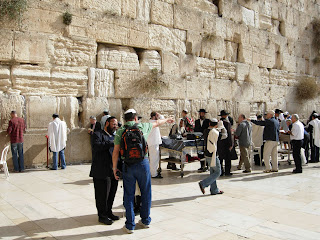
Just below the Dome of the Rock in the picture above is the "Western/Wailing Wall". The picture is looking east from the Jewish quarter. It is difficult to appreciate the size of the Temple Mount walls from any pictures I took. The wall is probably 60 feet high (or more) and surrounds the entire mount. Here is a close-up of the Wailing Wall.
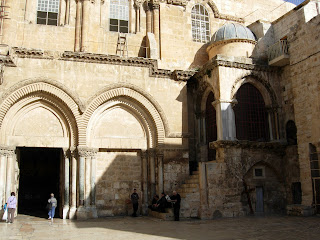
As for the Christian part of Jerusalem, it is difficult to describe the experience. It is not what most would hope for. The Church of the Holy Sepulchre is likely the site where Christ was crucified and buried, but it is now an ancient church with numerous rooms, chapels and relics. Here is a picture of the front door and a video to give you a feel. Not the windswept hill you picture when you think of Calvary.
Monday, December 15, 2008
More to come
Sorry to all who were looking for days 2-4 from Israel. Our internet access was not as good later in the trip, but more than that those sleepless nights earlier just caught up to me and I just didn't have the patience to sort through all the pictures. I'll post more after tomorrow (the last day of my semester). I appreciate your prayers in the meantime. I am still dragging a bit.
Monday, December 8, 2008
Day 2 - Jerusalem - New City

We had one day in the holy city and we made the most of it. It was an interesting contrast of the ages. We woke to a view out the window of this suspension bridge at an angle and curve. It must be a landmark, but I had never heard of it.
The drive to the old city was fascinating. After trying to make a shortcut, our GPS system took us through some really tight streets in an Orthodox Jewish neighborhood during the morning walk to school/work. I wish I had a picture of it. There were kids of every age all over the place, and it was crazy how closely they walked to the traffic. I got honked at a few times for keeping my speed in check with all the people.
Day 1 - Qumran
(Here's the picture from the Dead Sea)
From Masada we drove north along the west coast of the Dead Sea to Qumran. Qumran is at the at the northwest tip of the Dead Sea. This little village was occupied at the time of Jesus' ministry and until the Romans put down the Jewish revolt in AD 70. Qumran is a little unique for it's interesting aquaduct system that runs through town and even right next to a central dining room of sorts. The aquaduct is pretty small, and there is debate about the function(s) it played. You can see it snaking below. 
The aquaduct ran down from the mountains in the background of the next picture. If you look close, you can see a couple of the famous Qumran caves on the hillside. These are two of the caves where the Dead Sea Scrolls were found.

We hiked up to get a closer look at the caves. We found the entrance to one of them, but the big cave you see was pretty far up there. We thought we were getting close, but it was still a good 100 feet above us. There is a marked trail for backpackers that starts at Qumran and goes back past the caves and through the mountains. You can make out one more cave from this picture.
We drove just a little further north and then cut over to the west to come into Jerusalem from the hilly east side. It was tough to see much at night, but still exciting to be in the city.
Sunday, December 7, 2008
Day 1 - To the Negev
That is, to the south. That is where we went today, southeast from Tel Aviv to Masada first. It was almost a three hour drive and the terrain looked a lot like New Mexico and Arizona.


Karen will be proud to know that we hiked up the mountain to Masada. (Her guide made them hike the 1.5 miles when she was here) Most people take the cable car up and then some walk down. We took the cheaper option and rode the cable car back down. You can read more about Masada from the link on my last page if you want to. It was an impressive site.


We took a quick dip in the Dead Sea. I wasn't all that excited about this, but I have to confess that it is quite the experience. I felt like a fishing bobber sitting in the water. You just can't sink. If you flip over on your belly your feet kick right back to the surface. Our guide book describes one cruel Roman ruler following some sick tradition of binding and throwing in few men on arrival just to see if they would really float. Sick, but I have to tell you that they would indeed have floated. Even I, with no body fat at all, never even got my head wet.
Karen will be proud to know that we hiked up the mountain to Masada. (Her guide made them hike the 1.5 miles when she was here) Most people take the cable car up and then some walk down. We took the cheaper option and rode the cable car back down. You can read more about Masada from the link on my last page if you want to. It was an impressive site.
We took a quick dip in the Dead Sea. I wasn't all that excited about this, but I have to confess that it is quite the experience. I felt like a fishing bobber sitting in the water. You just can't sink. If you flip over on your belly your feet kick right back to the surface. Our guide book describes one cruel Roman ruler following some sick tradition of binding and throwing in few men on arrival just to see if they would really float. Sick, but I have to tell you that they would indeed have floated. Even I, with no body fat at all, never even got my head wet.
Saturday, December 6, 2008
Erev Tov
Erev Tov!! That is, "good evening" in Hebrew. Or maybe I should say boker tov (good morning). Right now the clock on my computer says 7:30PM and the clock by my bed (in Tel Aviv) says 3:30AM. I slept for a couple of hours this evening, and now I just can't fall back asleep. So I decided to break my blog silence on the occassion of my first trip to Israel.
Most anyone who would check this blog already knows the occassion for the trip, so I will just post a picture of the night sky from our hotel room on this dark and dreamless night.

Tomorrow we are heading south to the sites of Qumran, near where the Dead Sea Scrolls were found about 60 years ago, and Masada, the last standout for a group of Jews who were part of the revolt against the Romans from AD 66-73. Jerusalem was sacked and destroyed in 70, but the group held out on Masada for another three years!
We're staying the night in Jerusalem tomorrow night, and then in Tiberias on the Sea of Galilee the next two nights. More soon...
Subscribe to:
Posts (Atom)